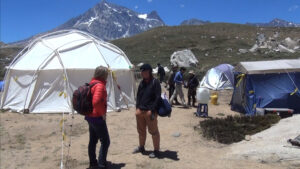
Eric looked the part—thirties, fit, steady. The kind of guy you trust around heavy equipment and ancient history.

He didn’t waste time. “I’m Eric,” he said. “Marine archeologist Franck Goddio wants me guide you. We’re collecting high-resolution sediment vibracores in and around the sunken city of Heraklion—and in Alexandria’s Eastern Harbor, right over the ruins of Cleopatra’s submerged palace.”
That got everyone’s attention. He continued, laying it out like a mission briefing. “We need 20-foot continuous cores. Four inches in diameter. Clean pulls. Once they’re up, they get capped, secured and will be shipped to Smithsonian Institution. They’ll slice them into razor-thin sections.”
Why? Because somewhere inside those layers, compressed, silent, untouched for centuries—were the answers. Goddio believed the story of how an entire palace… an entire city… slipped beneath the harbor and into the Mediterranean was locked inside those sediments.
Godddio had one non-negotiable rule. “We do not damage antiquities,” Eric said. “I’ll guide the leading edge of the vibracore barrel. If there’s anything down there—stone, structure, artifact, we must avoid it. Period.” Then he added, almost casually: “We’ll do this about six times a day. Every day. Until we get all the cores we need.”
For Aqua Survey, Inc. (ASI), this wasn’t unfamiliar territory—at least technically. We had a long track record of deploying our Rossfelder Electrovibracore systems around the world, pulling sediment cores for geotechnical and ecotoxicological analysis. Mud, sand, silt—we knew how to deploy equipment and personnel to just about anywhere.
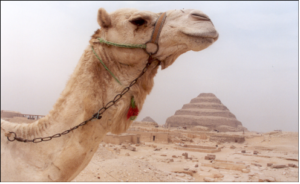
But this… this was different. Egypt, 2001—this was ASI’s first true archaeological sediment coring project. This time, the mud wasn’t just mud. It was history.
Every core we pulled had the potential to explain a disappearance that had baffled historians for centuries. Every sliver of sediment might carry a clue—earthquake, subsidence, rising seas, human intervention—waiting to be revealed one razor-thin slice at a time.
Since that project, ASI has gone on to support numerous marine archaeological missions, utilizing sediment coring or advanced geophysical surveying and sometimes both.
But this was the one that started it. This was the first time we pushed a core barrel into the ancient past to write history books