By: Ken Hayes
New York has many secrets. Some are known and others unknown. On September 27, 1903 the Guggenheim family lost a fortune in silver ingots in the Arthur Kill Waterway. There are still maybe one thousand, 102-pound ingots unaccounted for. Right in New York Harbor. Most flights out of Newark International Airport fly over them each day. We think.
The Guggenheims barge, The Harold, turtled at some point between South Street Seaport (Easy River, Manhattan) and its destination (ASARCO, Perth Amboy, NJ).
The survey team will need to do historical research to determine exactly where between Lower Manhattan and Perth Amboy the cargo loss most likely had occurred.
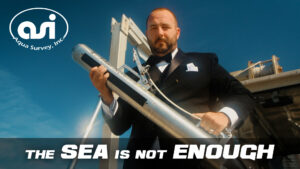
To be able to locate and recover the silver, the salvage team must know the maximum distance a 102-pound silver ingot might have settled into the river bottom. To determine that, ASI vibracoring teams have vibracored with our Rossfelder VT6. The VT6 has two 3-horsepower vibrational motors and weighs about 300 pounds. Many of our projects require us to collect a sediment core to the point of refusal…that is the point where the leading edge, the nose cone, can no longer advance into the sub bottom of the river. Typically, in a waterbody like the Arthur Kill you may have exposed sand or a very layered bottom—starting with unconsolidated sediment (black mayonnaise), then moderately consolidated sediment (Play-Doh), next consolidated sediment (hard to gouge with a screwdriver) or rock. To understand how deeply the ingots may be buried we need to know at what depth the consolidated or bedrock begins.
The next step is to make sure your electromagnetic metal detection equipment can resolve a 102-pound silver object at the maximum distance to the consolidated sediment/bedrock.
Once research is complete, maximum target depths are known and detection capabilities can get to the distance, you now just have a few more hurdles:
The waterfront has always been a tough guy place. You need to make peace with folks who believe they own the waterbody. And then the other group of folks that thinks treasure hunting is a tawdry get rich scheme. And that is failing to mention the State of New York doesn’t allow it even if you get permission from the New York District and Fish and Wildlife.
So for right now, Aqua Survey continues to work on improving our electromagnetic metal detection systems. The vibracoing has revealed exactly how deeply buried the silver ingots lie resting. We are working out the particulars to return to the Arthur Kill Waterway to pinpoint the Guggenheim’s lost treasure. We will let you know if we find it. In the meantime our improved metal detection electronics are better able to survey for UXO, pipelines, wrecks and archeological artifacts