By Ken Hayes
Fifteen years before our arrival, villagers working along the Mekong River floodplain in Bokeo Province, Laos, began uncovering unusual artifacts—several 6-12-inch bronze Buddha statues, lead religious medallions and other bronze artifacts that clearly did not belong to contemporary village life. Their discoveries pointed to something larger: the likely presence of a major Buddhist temple buried somewhere beneath the sandy soil.

But how could a temple simply vanish?
The answer lay beneath our feet. The site sits on a sandy Mekong River floodplain in one of Southeast Asia’s more tectonically active regions. This area, within the infamous Golden Triangle, for centuries has been plagued by monsoonal flooding, major tectonic activity, shifting sediments, and unstable ground. In such conditions, a massive brick temple could just cataclysmically sink in minutes and disappear into what is, essentially, natural quicksand.
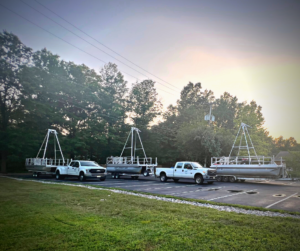
At the request of the Lao National Museum, Aqua Survey, Inc. mobilized a geophysical survey team and transported our advanced electromagnetic metal-detection systems into the Golden Triangle region. Our mission was clear: locate additionl bronze Buddha statues believed to have once stood within the temple complex so that archaeologists could excavate them carefully by hand. The grand prize would be for our team to locate the temple’s central massive bronze Buddha statue.
For days we surveyed the site. The instruments responded constantly—metallic anomalies scattered across the floodplain. Each promising signal was flagged. Each flag was followed by careful digging. Every target turned out to be modern debris. Bottle caps. Fragments of wire. Random pieces of recent human activity that had worked their way into the soil.
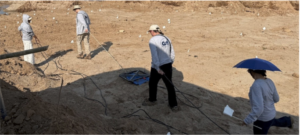
Meanwhile, the excavation team continued lowering a massive trench using track hoes. After each progressive deepening, we surveyed the new layer, searching for signals that might reveal the temple. The trench widened steadily, creeping outward until its edge reached a nearby zucchini field. By then the excavation had descended nearly twenty feet below the present ground surface.
Then something changed.
Embedded at the bottom of the trench wall were fired bricks—distinctive temple bricks. The unmistakable signature of ancient construction.
Standing at the center of that deep cut in the earth, we could look up and see the modern agricultural field above us. The temple lay buried directly beneath a zucchini field.
For that moment, the dig had to stop. The zucchini crop above the trench could not be legally disturbed until after the harvest.
But the mystery is far from over.
This spring we will return to Bokeo with expanded electromagnetic surveys and a renewed excavation effort aimed at revealing the lost temple beneath the Mekong sands. It will be the Aqua Survey geophysical survey team’s fourth archeological trip to Bokeo to support the Lao National Museum. A documentary film crew will again accompany the expedition, capturing a rare behind-the-scenes look at how modern geophysics can guide and support serious archaeology.
Somewhere beneath that quiet field lies a 500-year old temple that vanished centuries ago.
And we intend to find it.