We're here to help:
Symposium News, NASA Astronaut Joins Speaker List
Dec 15, 2011
It’s official! NASA astronaut Dr. Rick Linnehan will be giving a special presentation to the attendees of the 2012 Mid-Atlantic Contaminated Sediment Symposium.
A veteran of four space flights, Dr. Linnehan has logged over 58 days in space, including 6 EVAs (spacewalks) totaling 42 hours and 11 minutes. In August 2009 Linnehan returned to the Astronaut Office after completing a Master’s degree in Public Administration at the Harvard Kennedy School of Government in Boston, MA. Dr. Linnehan is currently assigned to a 12-month tour of duty at NASA Headquarters, Washington, D.C.
Linnehan, who served as chief clinical veterinarian for the U.S. Navy’s Marine Mammal Program before joining NASA, is a truly engaging speaker who is able to convey the diverse and intriguing experiences of his life to audiences in a fun and compelling manner.
While the other symposium presentations might be a little bit more down-to-Earth (literally speaking), we are no less excited by the rest of the lineup of fantastic speakers we have planned for the day.
The 2012 Contaminated Sediment Symposium is being held at an intimate venue in Liberty State Park near the Statue of Liberty. There are still a few seats left but you will need to act quickly.
Contact Aqua Survey’s Don Nazario ASAP ( or 908-347-4104) to inquire about available seats.
Back from Cleopatra’s Palace
Nov 09, 2011
Archeological diver and Aqua Survey employee Eric Wartenweiler Smith recently returned from an expedition in Egypt diving on Cleopatra’s sunken palace as part of renowned underwater archeologist Franck Goddio’s dive team. Read on to find out his thoughts on:
-Life in post-revolution Egypt
-Tantalizing news on what still waits to be found in the murky depths of Aboukir Bay
-The future of underwater survey technology
Aqua Survey would like to welcome Aqua Survey employee and archeological diver Eric Wartenweiler Smith back from his annual trip to Egypt.
Each year, Smith participates as a member of renowned archeologist Franck Goddio’s dive team. Goddio is responsible for the discovery of Cleopatra’s sunken palace as well as Napoleon Bonaparte’s flagship. Smith has participated in Goddio’s expeditions since 1996.
No stranger to Egypt, Smith wasn’t sure what to expect in returning for the first time to the country post-revolution. “Besides hearing the firsthand accounts of the revolution from my Egyptian friends, and witnessing many demonstrations and marches in the streets as the process of forming a new government unfolds, I was also particularly impressed by the attitude of the people I met in the street; there was a palpable air of national pride and friendliness, and a real sense of energy and purpose in the young people.”
When asked whether this year’s expedition had any interesting finds, Smith smiled and replied, “While I can’t give specific details, I can say that we’ve found some very exciting new discoveries this year. Franck has said before that we have only found 1% of the artifacts out there and I believe it. I’m excited by the ramifications of what these new discoveries will reveal about ancient Egyptian culture.”
Smith has seen a lot of changes in the field of underwater archeology during the past fifteen years. One of the biggest changes he’s observed is in the survey technology used. “The technology that we’re using now has revolutionized what we’re capable of. The tools we were using just a few years ago seem archaic in comparison. It’s interesting to note that the tools that are revolutionizing underwater archeological work are the very same ones that Aqua Survey uses on a daily basis. It’s a very exciting time to be involved in underwater survey work of any kind.”
Although Egypt, its history and its people hold a certain appeal to Smith, he’s happy to be home and looks forward to getting back in the field with Aqua Survey.
Iconic New York Landmark Keeps Up with the Times
Nov 03, 2011
Due to the renovation of the Panama Canal, the Bayonne Bridge is about to receive a similarly impressive upgrade.
Read on to find out more about the construction of this fascinating bridge and its currently proposed upgrade.
Plus: What services is Aqua Survey providing to support harbor expansion?
Last week Peter Zantal, a general manager at the Port Authority of New York and New Jersey announced that the raising of the Bayonne Bridge by 60 feet would be completed by 2016. Post-renovation, vessels will have 215 feet of clearance under the bridge, allowing the newer, larger Post-Panamax size vessels through.
A modern engineering feat of its day, the Bayonne Bridge has made it possible for commuters to drive easily from Staten Island, New York and Bayonne, New Jersey across the Kill van Kull since 1931. It’s been a pivotal part of expansion and transportation in the area and its intricate work and astute design has enabled it to last for nearly 80 years.
Created through collaboration between master bridge-builder Othmar Ammann and famed architect Cass Gilbert, the bridge has the distinction of being the fourth-longest steel arch bridge in the world. It was designated a National Historic Civil Engineering Landmark in 1985 by the American Society of Civil Engineers.
The Swiss-born Ammann designed seven of the twelve bridges which connect New York City to its surrounding areas. Ammann became known for creating bridges that were not only cost-effective and durable but also beautiful, which made him quite sought after during the Depression era.
Ammann chose the design of the bridge, a steel arch, over other bridge types as it was cheaper and would accommodate an addition in the future of rapid transit tracks. Soaring 266 feet over the Kill van Kull the bridge is 8,640 feet long.
After three years of construction, the Bayonne Bridge was completed on November 15, 1931 and cost nearly $13 million. At the time of its completion, it was the longest steel arch bridge in the world.
A Continued Tradition of Innovation
In a similar innovative spirit to Ammann’s work, the Port Authority has devised a plan for the renovations which will allow the bridge to remain open to motor vehicle traffic during the entire project. The Bayonne Bridge supports thousands of vehicles per day, in fact as of 2003, it was found that more than 20,000 vehicles per day cross between Staten Island and Bayonne. In order to allow this traffic to continue unobstructed a new platform will be constructed above the current one while traffic continues below. When the new platform is complete, the old one will be demolished, thus giving the bridge its new clearance height.
The Port of New York and New Jersey is the largest on the east coast. In 2010, over 32 million metric tons of goods worth more than $175 billion came through the harbor.
The More Things Change, The More They Stay The Same
Renovating New York Harbor is nothing new and has in fact been underway for many years in order to accommodate bigger and bigger vessels. Aqua Survey has been there in one way or another for decades to support this ongoing expansion, particularly to our clients in the dredging industry who we routinely provide services to ranging from hydrographic surveys and sediment sampling to laboratory analyses and much more.
You may have noticed the USS Chester in the graphic above. It’s the same ship which was pictured traveling through the Panama Canal in August’s email about the reengineering of the Panama Canal. Aqua Survey President Ken Hayes’s father served on the Chester during World War II. He was only 17 when he enlisted in the Navy.
Bombs, Elephants and Puerto Rico
Oct 28, 2011
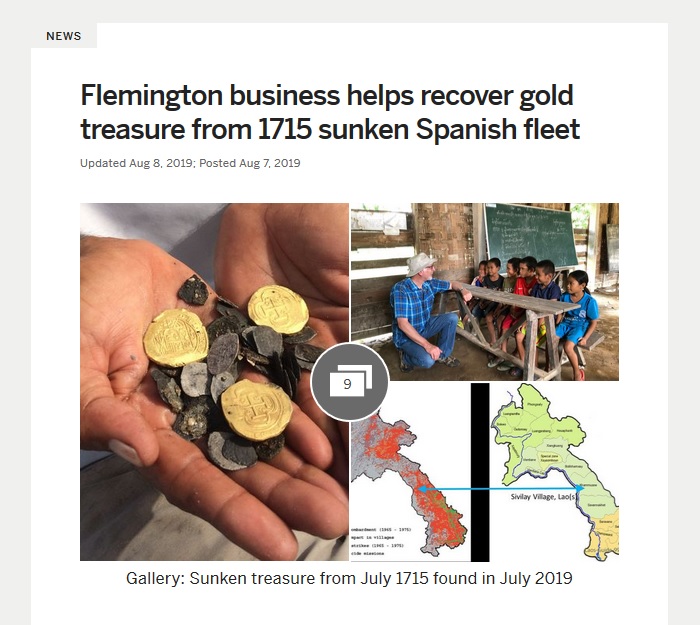
Traveling everywhere from gold mines in Laos to military testing grounds near Puerto Rico, and having used just about every conceivable form of transportation from airplane to elephant to do it, it’s been a busy month for Aqua Survey founder Ken Hayes. Read on to find out more.
Did you ever live through a month that no amount of imagination could have ever envisioned?
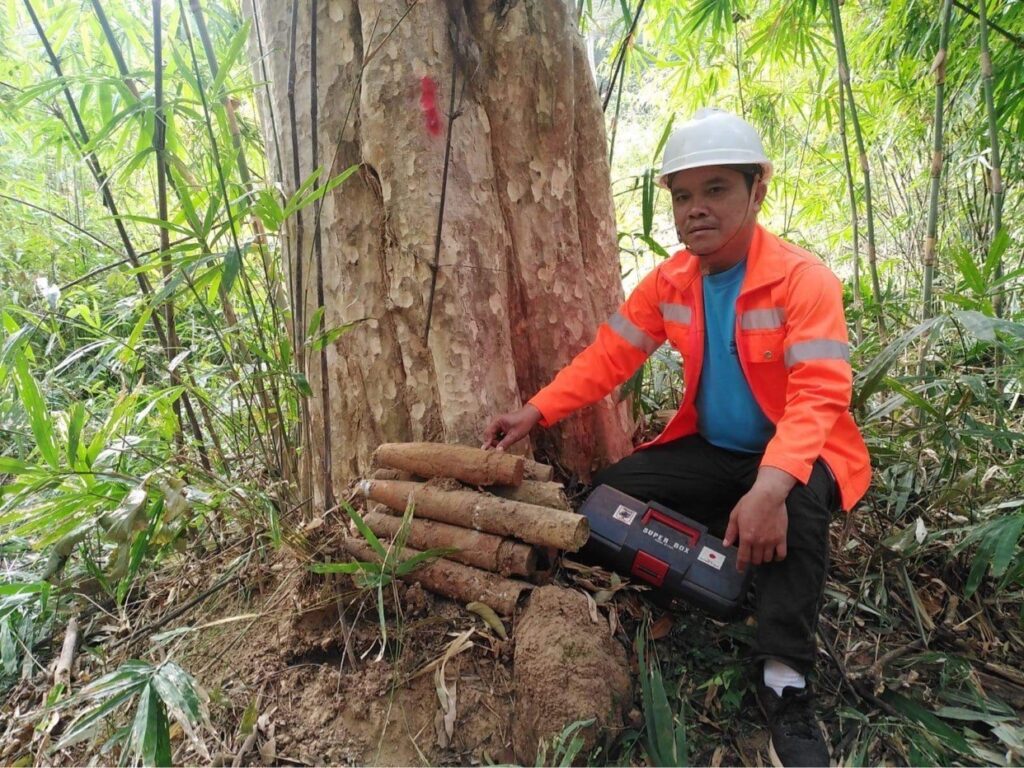
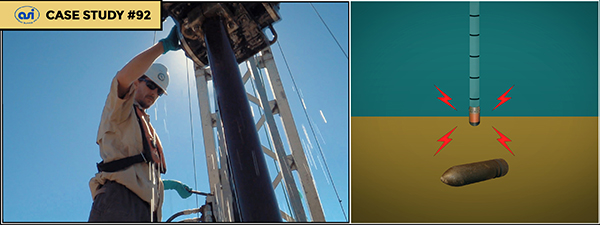
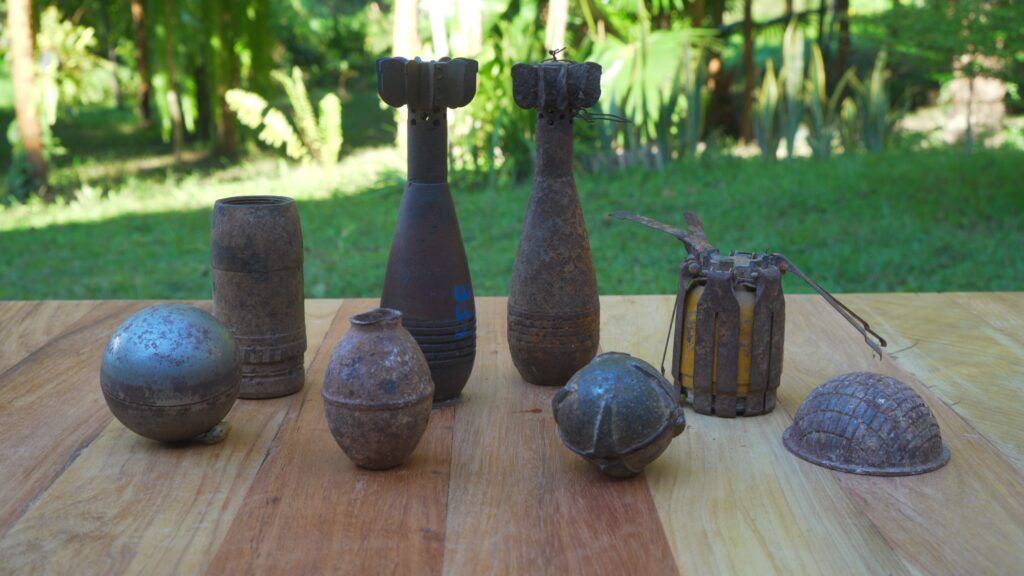
I am in that month right now. I have traveled to dozens of countries for business and pleasure in the past. This month I traveled to the remote jungles of Laos to demonstrate some electromagnetic metal detection equipment we designed to meet some pretty demanding unexploded ordnance (UXO or bombs) detection specifications. The bombs are Vietnam vintage and now buried in the jungle’s metal-rich soil. The soil is magnetic and conductive and has foiled effective use of other UXO detection technologies in the past. The bombs continue to kill or maim villagers on a daily basis. Our analog down-hole probe and our digital survey equipment tested well. That is just part of the story.
Philadelphia to Toronto to Shanghai to Kunming (China) to Bangkok to Ubonratchthani (Thailand) and finally to Sepon from Savannkhet (Laos) by chopper to a remote mining camp in the jungle. A low altitude chopper flight is an amazing way to take in an incredibly dense jungle sprinkled with a few dozen isolated rice paddy villages.
About 30 miles outside of Sepon is a gold and copper pit mining operation that the Ho Chi Minh Trail runs right through. Forty years ago we tried to bomb this Vietcong supply route into oblivion. The area now is strewn with thousands, if not millions, of unexploded bombs. The mining camp has taken the admirable initiative to train the villagers to use modern detectors to locate and then dispose of the bombs. The Vietcong also strung trip-wire booby-traps. What a mess. To date about 80,000 munitions have been safely removed. The new equipment we left behind will allow the field teams to detect more deeply buried bombs thus greatly increasing safety, efficiency and effectiveness.
When I left New Jersey I already knew our equipment would work unless some unknown phenomenon would mug us. There would be a lot of firsts for me on this trip:
China, Thailand, Laos and Japan
Living in a shipping container
Being in a jungle with wild elephants
Working in a communist country
Walking in areas with cobras and UXO
Experiencing the spiritual center of Laos, Luang Prabang
My mom was a little concerned her 58-year-old son might not be as safe in the jungles of Laos as he would be in Flemington, New Jersey. Mom...not even one mosquito bite...relax. Last week Bill Rottner and I did a site visit to Vieques Island, Puerto Rico in advance of upcoming UXO survey tasks. The place is covered with diabolical plants. After the work portion of our trip was over, Bill and I decided to grab our snorkel gear and head to the public beach where I promptly stepped on a sandbur plant. My foot still hurts. The moral of this story is to pay attention to the really little things, because they are the ones most likely to cause you pain.
Our goal as a company has been the same since 1975: To leave this watery-blue planet in a better shape than we found it. We pride ourselves in finding a way to get both big and small projects done safely and professionally.
World’s Top Marine Archeologists Celebrated by Aqua Survey, Inc.
Sep 29, 2011
During October 2011, Aqua Survey is offering the chance for you to spend a day with Eric Wartenweiler Smith, a world-class archeological diver, and receive a copy of the book by Franck Goddio, the renowned archeologist who discovered Cleopatra’s Sunken Palace. Scroll down to find out how, and also read the latest update on the Sediment Symposium.
A Special Offer - Spend a Day with a World Class Marine Archeologist
Imagine being able to work alongside Frank Goddio, the world renowned archeologist who discovered Cleopatra’s sunken palace. As you look for lost Egyptian antiquities, you never know what you will find. Eric Wartenweiler Smith gets to do this as part of his job; he is an archeological diver and Aqua Survey employee. Smith is currently on his annual trip to Egypt as a member of Goddio’s dive team to discover more ancient artifacts obscured in Egypt’s murky waters.
Smith, who has been working with Goddio since 1996, will return next month from this year’s expedition.
To celebrate, we would like to make a special offer available to you.
If you request a quote from us, we will send you a copy of Frank Goddio’s latest book, Cleopatra: The Search for The Last Queen of Egypt, which Smith will autograph when he returns from this year’s expedition.
Send us a request for quotes for two jobs and we will send you Goddio’s latest book, and in addition, you will receive two other books detailing Goddio’s work in Egypt: Cleopatra’s Palace: In Search of A Legend and Napoleon’s Lost Fleet. Both books feature exquisite underwater photography, which you will enjoy just for requesting two quotes.
Want an even bigger incentive? Send us a request for a quote on a job of over $125,000 and we will fly Smith out to meet with you. He will also give a presentation to the school, business, or other organization of your choice. He will describe his experiences as a marine archeological diver who has worked with Goddio for the last fifteen years. The stories he tells will captivate any audience.
Get your requests submitted by October 31, 2011 to receive these bonuses. Be sure to mention this offer.
To request a quote, simply call or email Senior Project Manager Tom Dolce today:
908-788-8700
Incredible Journey Leaves Lasting Impression
Aug 30, 2011
“At age 17, my dad, Robert E. Hayes (top left), quit high school to join the Navy. When I was a kid in the 1950’s, WW2 was still fresh in the minds of my relatives. My dad never shared the gory side of war with his kids, but he did share his experience of transiting the Panama Canal on the heavy cruiser USS Chester. He and my uncles talked about the amazing canal the same way we talk with amazement about apps for our smartphones today. The canal was the pipeline that connected my Jersey-boy dad to the Pacific Theater. In fact, he was probably on the ship when the above picture was taken.”
-Ken Hayes, President/Founder Aqua Survey, Inc.
Once able to handle the major warships and freighters of its day, the Panama Canal is being reengineered to accommodate today’s mega-sized cargo ships. Built to allow a container ship of up to 965 feet, commonly referred to as a “Panamax” size vessel, through its system of locks, the canal is currently undergoing renovations to allow “New Panamax” vessels of up to 1,200 feet to pass through. Set to be completed in 2012, the updated canal system will have far reaching implications around the world as port infrastructures are forced to gear up in order to accommodate the larger vessels. Aqua Survey has been providing sediment coring and laboratory testing to support harbor deepening projects worldwide.
Glacier Dwarfs Skyscrapers: Icy Past Revealed
Aug 25, 2011
Notes from the Field: Ancient Oysters
“Recently we were collecting sediment cores in New York in support of a harbor deepening project. The goal was simple, penetrate deeply until the glacial till is reached. This was a reasonable goal for one of our heavy-duty vibracoring systems. When the sample was retrieved and split open we discovered a strata of oyster shells from an ancient bed that most likely dates back to the Pleistocene era (1.8 million to 10,000 years ago).”
-Don Nazario, Senior Environmental Scientist, Aqua Survey, Inc.
The shell layer which Don found last week is just one reminder of the rich geological and biological history of New York City and its surrounding waterways. The region and harbor owes much of its current configuration to the last ice age when the Laurentide ice sheet advanced and retreated over a period of 60,000 years, reaching its last peak 22,000 years ago. New York City marked the southernmost extension of the ice sheet, which covered hundreds of thousands of square miles in what are now Canada and the northern United States. Ten thousand years ago global warming accelerated and the region went through drastic changes. Spruce and tundra were quickly replaced by pine forests and the mammoths and mastodons which once thrived in the region died out. These transformations are thought to possibly have happened within the lifespan of a human being. It’s intriguing to imagine how the Paleo-Indians survived such rapid changes.
At its tallest the Laurentide ice sheet covered New York City with a thousand feet of ice. If New York City was to be covered in that much ice today, only a handful of buildings would poke through, the most prominent being the Empire State Building.
-Part 1 of a 3-part Series on the Deepening of New York Harbor-